
Investing in a brand-new roof is one of the most significant and protective upgrades you can make for your home. Whether you are protecting a historic property in Kensington or a modern estate in Potomac, you select premium shingles, secure a top-tier warranty, and trust that your home is safe from the elements for decades to come.
However, many Maryland homeowners overlook a critical reality: your roof does not operate in a vacuum. A roof is part of an integrated structural anatomy designed to shed water away from your property. If your gutter system is clogged, undersized, or failing, it can completely undermine your investment. Here is how poor gutter drainage can quietly destroy a brand-new roof from the edge up.
The Anatomy of the Roofline: A Connected System
To understand how gutters affect a roof, it helps to understand how the lower edge of your roof—known as the eave—is constructed. This area consists of several tightly integrated components:
- The Roof Deck: The structural wooden sheathing (usually plywood or OSB) that forms the foundation of your roof.
- The Drip Edge: A metal flashing installed along the edges of the roof deck designed to direct water away from the wood and safely into the gutters.
- The Fascia Board: The horizontal architectural band running along the roofline where your gutters are physically mounted.
- The Perimeter Shingles: The starter strips and first courses of shingles that overhang the roof edge.
When working correctly, gravity pulls water down the shingles, over the drip edge, and straight into the gutters, which carry it safely away from your foundation. But when the gutters fail, this entire system runs in reverse—a problem we see frequently across Montgomery County homes surrounded by mature tree canopies.
How Overflowing Gutters Destroy a New Roof
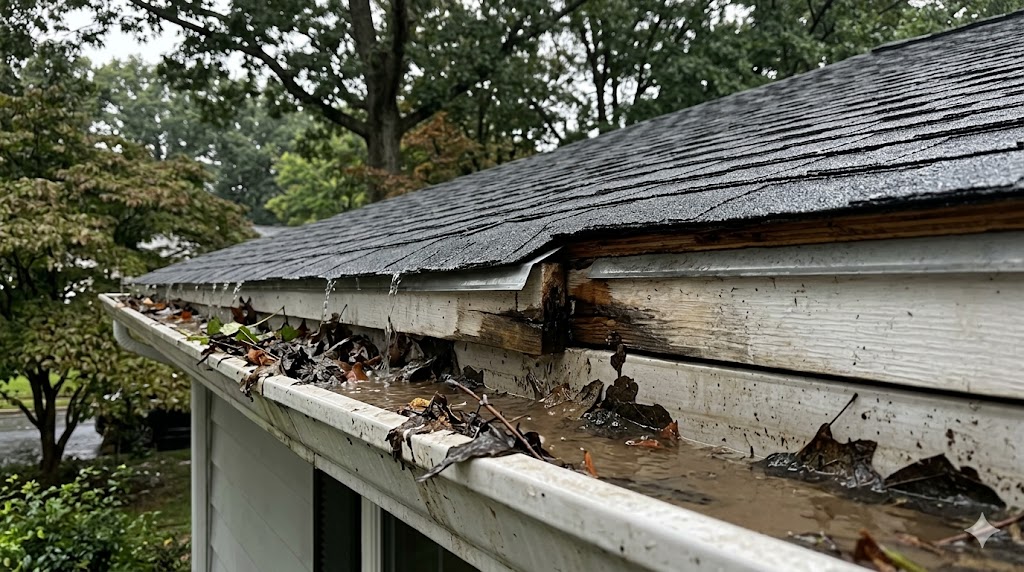
When gutters fill with leaves, pine needles, or thick spring pollen sludge, rainwater has nowhere to go. During a heavy downpour in areas like Silver Spring or Bethesda, the water rises and creates a destructive chain reaction.
- 1. Water Backs Up Under the Fascia and Roof Deck
- When an open-top gutter clogs, water doesn’t just spill over the front edge onto your landscaping; it pools backward against the fascia board. If water rises higher than the metal drip edge flashing, it makes direct contact with the exposed wooden edge of your roof deck. Over time, constant exposure to trapped moisture causes this wood to soften, rot, and split.
- 2. Perimeter Shingle Delamination
- Shingles are designed to shed water that flows downward. They are not engineered to sit submerged in standing water. When clogged gutters cause water to back up, moisture can wick upward underneath the starter shingles. This persistent dampness breaks down the asphalt mat, dissolves the adhesive seals, and leads to curling, buckling, and premature shingle failure at the perimeter.
- 3. Sagging Fasteners and Structural Failure
- Traditional open-top gutters are often secured through the fascia board and directly into the rafter tails using spikes or brackets. When overflowing water rots the fascia board and roof deck, those fasteners lose their grip. The heavy, water-logged gutters begin to sag away from the roofline, creating a wider gap that allows even more water to penetrate the wooden structure of your home.
The Costly Reality: Standard homeowner insurance policies and manufacturer shingle warranties often exclude damage caused by a lack of routine maintenance. If a brand-new roof fails prematurely due to chronically clogged, overflowing gutters, the repair costs may come entirely out of pocket.
Safeguarding Your Investment in Montgomery County
If you are replacing your roof, or if you have recently invested in a new one, your gutter system deserves immediate attention. Protecting your roofline requires moving away from high-maintenance, failure-prone setups.
- Upgrade to Leaf-Free Systems: Relying on standard open-top gutters means gambling with the health of your roofline between cleanings—especially with the heavy oak and maple debris common in Rockville and Gaithersburg. Fully integrated, hooded leaf-free gutter systems utilize liquid adhesion to pull water into the trough while completely blocking leaves, twigs, and seasonal debris.
- Ensure Heavy-Duty Mounting: Look for systems that utilize high-capacity aluminum and secure brackets that protect the fascia from water exposure, ensuring the gutters stay rigid and properly pitched even during severe Mid-Atlantic storms.
- Inspect the Drip Edge: Always ensure a proper metal drip edge is installed during any roofing or gutter work to act as a physical barrier between your roof deck and the gutter trough.
A new roof is only as good as the drainage system supporting it. By pairing premium roofing materials with a permanent, clog-free gutter solution, you protect the structural integrity of your home from the top down.
Want to see how an integrated roof and gutter system keeps your home safe? Contact Mid Atlantic Gutters and Roofing, LLC today for a comprehensive evaluation of your home’s roofline anatomy. We proudly serve homeowners throughout Montgomery County, Maryland, and the surrounding areas.